The AVDL is a highly innovative robotic system that leverages a combination of affordable, off-the-shelf components and open-source software tools. It integrates advanced sensors and sophisticated algorithms to enable highly accurate autonomous navigation and landmine detection. The workflow of the AVDL is structured around two primary components, namely navigation, and landmine detection, which work seamlessly together in Robot Operating System (ROS) to create a highly effective, modular, and reliable robotic system for detecting landmines.

In the perception component, the AVDL utilizes a variety of sensors, including a LIDAR and an Intel RealSense camera, to build a 3D map of the surrounding environment in real-time. The map is processed using point cloud segmentation algorithms to identify and classify obstacles, such as trees, rocks, and buildings. The AVDL also uses a GPS and a compass to localize itself in the environment and determine its heading's direction. The localization data is combined with the 3D map to generate a global map of the environment, which is used by the navigation component to plan safe and efficient paths to the designated GPS waypoints.

In the navigation component, the AVDL uses a waypoint-based navigation system to move towards the designated GPS waypoints. The waypoint-based navigation system is designed to tell the robot how far it needs to move and rotate to reach the desired GPS waypoint relative to its current GPS location and compass direction. To ensure safe and collision-free navigation, the AVDL uses the LIDAR and RealSense cameras to detect obstacles in its path and to adjust its trajectory accordingly. Another important feature of the AVDL is its ability to navigate through different types of environments. The AVDL has been tested and proven successful in navigating through grass, roots, rocks, and sand. It can also navigate through an inclination up to 40 degrees. The AVDL's ability to navigate through different environments is crucial in detecting landmines in various terrains and situations.
In the navigation component, the AVDL uses a waypoint-based navigation system to move towards the designated GPS waypoints variety of sensors, including a GPS, LIDAR and an Intel RealSense camera. The waypoint-based navigation system is designed to tell the robot how far it needs to move and rotate to reach the desired GPS waypoint relative to its current GPS location and compass direction while actively avoiding obstacles and traversing over rugged terrain.
In conjunction with gathering the GPS data for navigation, the AVDL software simultaneously generates a satellite-view map of where the robot has been (represented by a blue line) and the locations of any detected landmines (represented by a red waypoint) all the while the robot is autonomously navigating to find landmines.

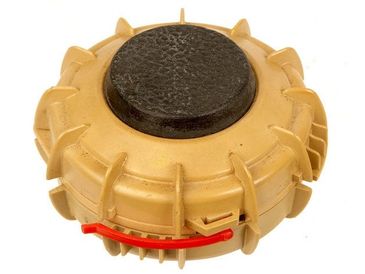
The AVDL uses computer vision and metal detection sensors to detect diverse types of landmines, including the VS50, PMN, and PFM-1. The computer vision algorithm used by the AVDL is based on the open-source YOLOv5 algorithm, which provides high accuracy and fast detection performance. When a landmine is detected, the AVDL returns the GPS location of the detected landmine and a screenshot of the detection if the confidence of the computer vision model is over 90% (a high accuracy threshold value was used to avoid false positives in the detection algorithm).
The AVDL's metal detector is also a reliable tool for landmine detection. It uses electromagnetic waves to detect metallic objects buried in the ground, which could indicate the presence of a landmine. The AVDL's metal detector has an accuracy of over 75%, which makes it a useful tool for detecting landmines in situations where computer vision algorithms may not be effective, such as detecting landmines buried deeper in the ground.


The AVDL's cost is another major advantage. The total cost of the AVDL is around $1000, which includes the cost of the chassis, camera, LiDAR, metal detector, electronics, case, and other miscellaneous expenses. The low cost of the AVDL makes it accessible to organizations and countries that may not have the resources to invest in more expensive technologies.

The AVDL's pressure level is also an important feature. The AVDL has been designed to minimize the pressure it exerts on the ground to prevent any accidental detonation of landmines. The AVDL's pressure level is 0.45 LB/IN^2, which is well below the minimum pressure required to detonate most types of landmines. This feature makes the AVDL a safe tool for detecting landmines.
In conclusion, the AVDL is a promising technology for detecting landmines using computer vision and a metal detector. Its ability to detect landmines with high accuracy, navigate through different environments, low cost, and safety features make it an accessible and efficient solution for landmine detection. However, it is important to note that the AVDL should be used as a complementary tool to human deminers and other methods for detecting and removing landmines. The AVDL has the potential to save many lives and help in the process of removing unexploded ordnance from affected areas.
Copyright © 2023 Autonomous Vehicle for Landmine Detection - All Rights Reserved.
We use cookies to analyze website traffic and optimize your website experience. By accepting our use of cookies, your data will be aggregated with all other user data.